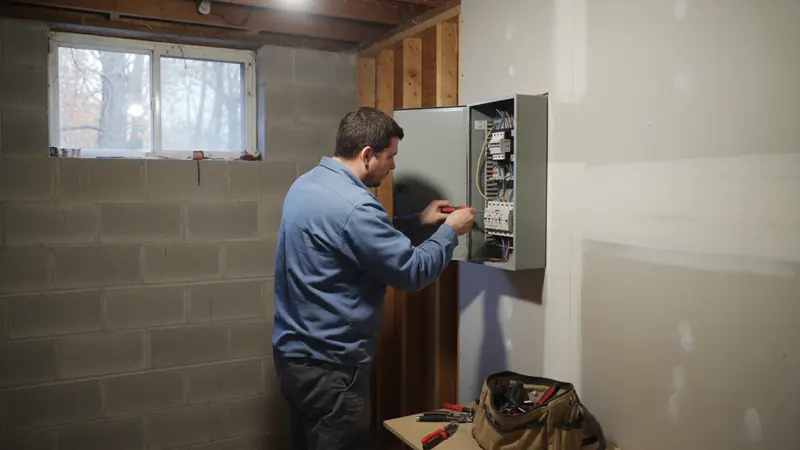
Electrical repairs, permits, inspections, county fees, and what local housing records tell you about the wiring behind your walls.
We've sourced every figure and recorded when we gathered it. A published fee is different from an estimated bill. Where we could not settle a question, we say so.
Do you actually need a permit?
If you're adding wiring, outlets, a service upgrade or a new electric-vehicle charging circuit, check whether you need a permit. Fairfax County uses the residential electrical record, ELER, in its Planning and Land Use System, or PLUS. Its permit guide covers new services, equipment and fixtures. It also covers replacements.
Replacing a broken switch is different from installing a circuit. Virginia's ordinary-repair exemption expressly covers replacement general-use switches, dimmers and control switches. It also covers 125-volt, 15- or 20-amp receptacles, lighting fixtures and ceiling fans. This applies to the residential occupancy groups specified in the regulation, including work serving an individual apartment. The exemption does not list service panels or new wiring. You may still need a permit in a special flood-hazard location.
The county pages do not say quite the same thing. The ELER guide broadly includes replacements. The county's general permit page exempts like-for-like electrical replacement without relocation. We follow the state's specific ordinary-repair list for the devices above. We do not take the county's broad wording to exempt a panel replacement. You can check what applies to your work with LDS at 703-222-0801.
If equipment fails, an emergency replacement may genuinely be unable to wait. The state rule lets you apply for the permit after starting that work. You must apply by the end of the first working day after work starts. Emergency work is not a permanent permit exemption.
Your apartment or condo may need the county's commercial electrical record, ELEC, even though you live there. Fairfax's commercial guide expressly warns about this distinction. Check your building's classification before using residential fees or application instructions.
Source: Fairfax County Land Development Services (LDS), Electrical (ELER)—Residential, Does My Project Require a Permit?, and Electrical (ELEC)—Commercial, undated guidance; Virginia DHCD, 13VAC5-63-80, sections 108.1 and 108.2(14.3), last amendment effective 2024-01-18. Gathered 2026-09-22.
What the permit costs
These are Fairfax County's July 1, 2026 charges under adopted ordinance 05-26-Q. Surcharges are extra.
| Electrical work or charge | Scheduled fee |
|---|---|
| Residential alteration: 1–100 fixtures, circuits and equipment | $141.75, the base minimum |
| Residential alteration: 101–125 | $153.30 |
| Residential alteration: 126–150 | $190.05 |
| Residential alteration: 151–175 | $226.80 |
| Residential alteration: over 175 | $265.65 |
| Service panel, subpanel or transfer switch | $78.75 each, subject to minimum |
| Generator | $78.75, subject to minimum |
| Reinspection, when assessed | $141.75 |
| After-hours, time-specific inspection | $316.05 per 30 minutes or fraction |
| Code Academy levy | 2% on applicable building-development fees |
| Technology surcharge | 10% of each transaction |
New dwellings have a separate fee schedule based on amperage. The residential alteration table does not cover them.
Do not read $78.75 as an all-in panel permit. The published minimum applies. Surcharges are separate. The schedule gives no worked example for a panel plus a circuit. It also leaves unclear whether the technology surcharge includes the levy. We cannot give you a combined-job total from that information. Check your charges with LDS at 703-222-0801 or in the issued PLUS fee detail.
Source: Fairfax County Board of Supervisors, Appendix Q—Land Development Services Fee Schedule, ordinance 05-26-Q, sections I-A, I-D and III; adopted 2026-05-05, effective 2026-07-01. Gathered 2026-09-22.
An EV charger has its own permit questions
Fairfax makes a useful distinction. You need an electrical permit for a new charging circuit or outlet. You do not need one to plug a stand-alone charger into an existing outlet. That exemption tells you nothing about the outlet's condition or suitability for the charger.
For a single-family dwelling, the county's EV guide says you need an electrical permit through PLUS. You need no EVCS plan submission. A larger project can have extra requirements. The guide also lists additional town approvals in Vienna and Clifton.
Shared parking changes things. Fairfax treats HOA property as commercial for this guidance. The installer handles permits, drawings and inspections. The association supplies site contacts. It also needs access to the record. Do not budget or plan for an association parking-area charger as though it were another outlet in a detached garage.
The old fee waiver has a date attached. County HOA and environmental guidance still describe an exemption ending October 31, 2025. That date has passed. The EV permit page now points you to the fee schedule. We could not verify a continuing exemption when we gathered this research. We cannot promise you a free permit. Budget using the ordinary fee schedule until LDS confirms the EV charges at 703-222-0801.
When you review a proposal, look for the charging equipment as a separate item. Any changes to the existing service should be clear too. So should the county charge. Even a confirmed fee exemption would not remove the permit requirement. You would still need the required inspections.
Source: Fairfax County LDS, Electric Vehicle Charging Stations Permits and Guide for HOAs Installing Electric Vehicle Charging Stations, undated guidance; HOA page states waiver through 2025-10-31. Gathered 2026-09-22.
How long the permit actually takes
We could not verify Fairfax's median time from residential-electrical application to permit issue. We cannot reliably promise you a number of days.
Fairfax publishes development metrics for individual workflow tasks. Its building-review figures exclude outside reviewers such as Zoning, Health, Wastewater and the Fire Marshal. They do not tell you the full elapsed time, including your contractor's preparation, corrections and payment.
If your job stalls, check its Processing Status under Record Info in PLUS. The county's Workflow Routing Slip Report shows reviewer assignments, due dates and actions. You can see whether the file is waiting for county review, a response or another condition. “With the county” does not tell you what needs to happen next.
If a repair leaves part of your home unusable, ask for separate dates in the proposed schedule. Permit issued. Electrician booked. Inspection booked. Approved paperwork does not tell you when the electrician will arrive. It does not tell you when the finished work will be inspected either.
Source: Fairfax County LDS, Land Development Metrics, undated live guidance and Workflow Routing Slip description. Gathered 2026-09-22. No end-to-end electrical timing statistic is claimed.
The inspections
Do not cover wiring before the required concealment inspection. Virginia requires electrical materials, equipment and systems to be inspected before you cover them up. You also need a final inspection where applicable. If the inspector finds defects, get them corrected. Have them reinspected before further work hides them. As the permit holder, you can ask which code section supports a written correction notice.
Fairfax's residential electrical inspection form lists several different visits. These cover electrical concealment, final, temporary-to-permanent service, temporary pole service, and pool structural-steel bonding. Your repair will not necessarily need every visit. A panel job may follow a different sequence from wiring a finished basement.
You book inspections in PLUS. The county's cutoff for requesting a next-business-day inspection is 11:59 p.m. To reschedule, cancel the old request. Make a new booking. You may face a reinspection charge if the job is unfinished when the inspector arrives.
Fairfax also requires related inspections to happen on the same day. If your remodel involves several trades, coordinate their concealment visits. Do the same for their final visits when work is complete. Check with LDS which inspections belong together. Do not assume your electrician can book independently of everyone else.
Have the approved plans available. Have any equipment needed for access ready too. For an after-hours electrical inspection, use the issued record's Make changes → After hours Inspection process. Staff assess the fee. They also assign an inspector.
You can use the county-approved third-party inspection route. Simply hiring a private inspector is not enough. You need an approved firm. Fairfax must also approve your project for the programme. The results must reach the county's system. Set this up before you rely on it to close your permit.
Source: Virginia DHCD, 13VAC5-63-130, sections 113.3 and 113.6, 2021 code cycle effective 2024-01-18; Fairfax County LDS, Building and Trade Inspections, Residential Electrical Inspection Report, and Third-Party Inspections Program, undated. Gathered 2026-09-22.
What the inspector is actually going to check
Fairfax publishes an Electrical Plan Review Record, updated July 2024, listing specific design checks. It is for plan review. It is not a complete homeowner inspection checklist. It does explain why your proposal may need to cover more than swapping visible hardware.
The document checks conductor sizing, panel and equipment locations, load calculations, panel schedules, grounding, and overcurrent protection. It also checks required ground-fault protection (GFCI) and arc-fault protection (AFCI). Other checks cover branch circuits, receptacle locations and lighting outlets. If you're upgrading a service or adding electrical load, ask whether the design establishes capacity for the actual equipment. Ask whether it provides the protection that equipment needs too.
A panel label alone cannot answer all of that. Ask for the proposal to list the existing equipment and circuits you will keep. Ask it to spell out what will change. You can then review the load assessment before the walls close. You can also check where the repair stops.
A public record shows what can fail on site. In Fairfax PLUS record ELER-2022-01521, the June 1, 2023 final inspection failed with comments about:
- Breakers that did not identify what they controlled.
- A bathroom receptacle without GFCI protection.
- Heater circuit and receptacle-rating mismatches.
- A bathroom switch that did not operate the expected fixture. A wall heater that did not work.
- Kitchen circuit requirements that had not been met.
“The lights come on” does not mean the electrical work is complete. The inspector found problems with labelling, protection, circuit suitability and operation.
This historical example does not give you a countywide failure rate. It is not a current code ruling for your kitchen either. It shows specific faults an inspector found. Your own permit's approved scope and applicable code determine what you must correct.
Source: Fairfax County LDS, 2020 Electrical Plan Review Record, version 20.0, updated July 2024; Fairfax County PLUS, ELER-2022-01521, final inspection result, dated 2023-06-01. Gathered 2026-09-22.
Who is allowed to do the work
Fairfax distinguishes a business's contractor license from an individual's tradesman or journeyman licence. The individual's licence does not expand the work or contract limits allowed by the business licence. The county directs you to Virginia's Department of Professional and Occupational Regulation, DPOR, to check licences.
Check the business that will sign your contract. The visiting electrician's name is not enough. The county's Hiring a Contractor page links to the state lookup. It gives 804-367-8500 for DPOR assistance. You can also check there whether the licence covers your proposed work.
The name on the permit matters. Fairfax recommends that your licensed contractor obtain it as the responsible party. The reason is practical. The county says enforcing requirements against a contractor is harder when you obtained the permit. If a contractor insists you take it out yourself, ask why before you sign anything.
You can obtain a permit as an owner. That does not automatically exempt you from licensing requirements. The county's License Exemption Affidavit, dated January 31, 2022, asks you to identify the exemption you claim. You must also affirm that the work will meet code. Its information sheet tells you to submit the affidavit if you intend to proceed without a licensed contractor.
The owner-permit paperwork establishes who takes responsibility. It does not make an unlicensed contractor licensed. You can ask LDS questions at 703-222-0801 before signing the form.
Source: Fairfax County LDS, Hiring a Contractor, undated; License Exemption Affidavit and Information Sheet, dated 2022-01-31. Gathered 2026-09-22.
Which code your job is held to
Virginia DHCD says the 2021 Virginia code family and 2020 National Electrical Code were adopted effective January 18, 2024. Those are the editions we found on the state's adoption page when we checked. Publishing a newer national edition does not, by itself, change Virginia's adopted requirement.
There is stale wording on the county's code page. Its introduction still refers to the 2018 International Codes. Its links include the 2021 Virginia codes and 2020 NEC. We follow DHCD's explicit adoption statement rather than that older introduction. Check which code applies to your existing permit with LDS at 703-222-0801.
Virginia also has an Existing Building Code for work to rehabilitate existing buildings. For your repair, what matters is the approved scope: what you will repair, replace, add or alter. A code change alone does not mean you must rewire an entire old house. Nor does an old installation date make damaged or altered wiring acceptable. If someone proposes correcting wiring throughout your house, ask them to identify the condition they found. Ask which requirement makes that work necessary.
Source: Virginia DHCD, Codes—Virginia Code Collections, adoption effective 2024-01-18, and 13VAC5-63-30, Application of Code; Fairfax County LDS, Codes and Standards, undated. Gathered 2026-09-22.
What Fairfax County houses are, and what goes wrong in them
The county's January 2024 housing-age inventory contains 434,745 units. Of those, 111,232 predate 1970. Another 83,129 date from 1970–1979. There are 93,851 from 1980–1989. The first two groups together make up 44.7%, calculated from the published counts.
The local differences are large. In Annandale planning district, 61.4% of the table's housing predates 1970. In Bull Run planning district, that figure is 6.9%. There, 37.7% dates from the 1980s. These are planning districts, not ZIP codes.
What the table counts matters. It excludes mobile homes, dilapidated structures, group quarters and certain other housing categories. Its total is not the county's entire housing inventory. The construction year does not tell you the age or material of every wire inside a building.
Look into an older house's wiring and renovation history. Its neighbourhood alone cannot tell you what is wrong. We could not verify a countywide count of aluminium-wired houses or defective panels.
Was your house or addition wired between 1965 and the mid-1970s? The U.S. Consumer Product Safety Commission says older aluminium branch-circuit wiring is a possibility. Its concern is that connections can deteriorate. That can increase resistance, causing overheating. Have a qualified electrician identify whether you have this wiring. Not every Fairfax home from that era does.
Replacing a panel does not tell you what remains at receptacles, switches or concealed junctions. If you find aluminium branch wiring, ask how the proposed repair will deal with connections throughout the affected system. The CPSC publication discusses ways to repair it. It does not give a Fairfax installation count or a local price.
There is firmer local evidence for more everyday faults. Fairfax's housing department lists damaged or inoperable outlets, missing or nonworking smoke detectors, and exposed unterminated wires among frequently failed Housing Quality Standards items. Its guidance also singles out damaged, missing or painted-over outlet covers.
Those findings come from the assisted-housing inspection programme. They do not give you a failure percentage for all owner-occupied houses. HQS is also separate from the electrical permit inspection. The findings do show that local inspectors encounter damaged devices and unfinished or unsafe wiring. Ask for your estimate to separate observed faults from optional modernisation. Conditions that still need investigating should be separate too.
Source: Fairfax County Department of Management and Budget, Demographic Reports 2024, table 6.10, Housing Unit Inventory by Year Built and Planning District, page VI-28, IPLS inventory January 2024; U.S. Consumer Product Safety Commission, Repairing Aluminum Wiring, Publication 516, June 2011; Fairfax County Department of Housing and Community Development, Housing Quality Standards Inspections—Most Frequently Failed Items, undated. Gathered 2026-09-22.
The short version
Settle what your repair covers before assuming you do not need a permit. Use the current county fee schedule, particularly for panel work or a charger. Check the itemised PLUS charges too. Keep the concealment inspection in your job schedule. Include the final inspection. Check who is responsible for the permit.
We could not find verified Fairfax County installed prices for panel replacement, rewiring and charger installation in the primary sources we reviewed. We have not substituted a local labour rate or national cost range. To compare proposals, ask for separate items: equipment, retained wiring, repairs, permit charges, inspections and making good afterwards. You can then see the differences without an invented “normal” county price.
Source: Fairfax County LDS, Electrical Residential permit guide, Building and Trade Inspections, and Appendix Q fee schedule, fee schedule effective 2026-07-01; guidance otherwise undated. Gathered 2026-09-22. Installed-price figures intentionally omitted.